If the Bible were true then everything that we know about history should match up perfectly with the Bible, but that is not the case. As we all know there are some historically accurate statements made in the Bible, things that the men who wrote the Bible would have already known. What apologists and church leaders fail to mention is that the Bible also makes a great deal of false historical claims.
a
Babylonian Exile
The Babylonian Exile only lasted 48 years, from 586 BCE when the temple was destroyed until the return of the Israelites to their promised land in 538 BCE after Cyrus overthrew the Babylonian Empire. Jeremiah 29:10 & 2 Chronicles 36:21 falsely say the exile lasted 70 years.
b
Jericho
The Bible says Joshua destroyed the wall of Jericho around 1400 BCE but Archaeological evidence shows that an earthquake destroyed the wall in 2300 BCE. The city was also thoroughly destroyed by a fire and then abandoned in 1600 BCE. Jericho was not inhabited again until 700 BCE. There was no wall to tumble down or citizens to destroy at Jericho within centuries of when the Bible says Joshua was there.
c
Belshazzar
Daniel 5:1-2 says Belshazzar was king of the Chaldean Empire (Babylon), and son/successor of Nebuchadnezzar. In reality, Nebuchadnezzar's son and successor was Amel-Marduk. He was assassinated by his Brother-in-law Nergal-Ashur-Usur, who took the throne. His reign was followed by his son Labashi-Marduk, who was opposed by a faction that overthrew him and placed Nabu-naido on the throne. Belshazzar (whom's name was actually Bel-shar-utsur) was the son of Nabu-naido. He was NEVER king, but crown prince, and was not related to Nebuchadnezzar.
d
Zombie Uprising
Matthew 27:52-53 claims that when Jesus died graves were opened as zombies rose from them and this was seen by many people. If a city under Roman occupation was invaded by zombies don't you think at least one contemporary historian would have written about it? Needless to say, there is not one historical documentation of an actual zombie uprising.
e
There Was No Exodus
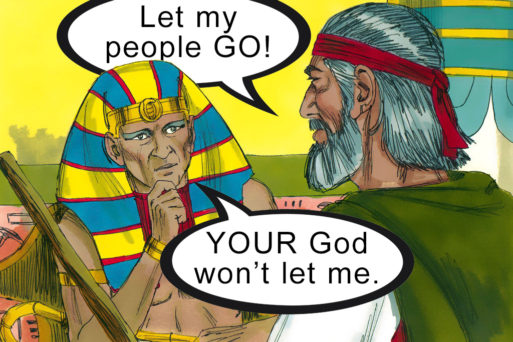
The Bible's story of Moses and the Israelites' exodus from ancient Egypt is purely fictional. Not only is there no evidence for the exodus but it also contradicts known history. Evidence shows that there was no major increase of people in Israel at the end of the supposed exodus. There were also no Jews, Israelites, or Hebrews in ancient Egypt. It was not until almost 2,000 years after the Great Pyramids were finished that we see the earliest record of Jews in Egypt. These Jews were also not slaves, they were soldiers who fought alongside the Pharaoh's soldiers. And contrary to popular belief the pyramids and other great monuments of Egypt were constructed by voluntary workers, not slaves.
Slaves Did Not Build the Pyramids
It is estimated that 10,000 men built the Great Pyramid over a span of 30 years. Archaelogical evidence shows that they lived in good housing at the foot of the pyramid, and when they died, they received honored burials in stone tombs near the pyramid in thanks for their contribution. They also ate well, received the best medical care, and were well paid. Egypt had no shortage of labor, especially during the months when there was no work to be done in the fields. The builders were recruited from poor communities and worked shifts of three months, distributing the pharaoh's wealth out to where it was needed most. Each day, 21 cattle and 23 sheep were slaughtered to feed the workers, enough for each man to eat meat at least once a week.
No Post-Exodus Population Increase
If there were a great Exodus to Israel as the Bible claims we would obviously have seen a population increase, there was none. Surveys of ancient settlements--pottery remains and so forth--make it clear that there simply was no great influx of people around the time of the Exodus (given variously as between 1500-1200 BCE). In Israel at that time, there was no population explosion. There was also no sudden change in the kind or the volume of pottery being made. If people suddenly arrived after hundreds of years in Egypt, their cups and dishes would look very different from native Canaanites.
No Jews In Ancient Egypt
No Egyptian records contain a single reference to anything in Exodus which is no surprise since there were not Jews in ancient Egypt. It wasn't until almost 2,000 years after the Great Pyramid received its capstone that the earliest known record shows evidence of Jews in Egypt, and they were neither Hebrews nor Israelites. They were a garrison of soldiers from the Persian Empire, stationed on Elephantine, an island in the Nile, beginning in about 650 BCE. They fought alongside the Pharaoh's soldiers in the Nubian campaign, and later became the principal trade portal between Egypt and Nubia. Their history is known from the Elephantine Papyri discovered in 1903, which are in Aramaic, not Hebrew; and their religious beliefs appear to have been a mixture of Judaism and pagan polytheism. Archival records recovered include proof that they observed Shabbat and Passover, and also records of interfaith marriages. In perhaps the strangest reversal from pop pseudohistory, the papyri include evidence that at least some of the Jewish settlers at Elephantine owned Egyptian slaves.
Other documentation also identifies the Elephantine garrison as the earliest immigration of Jews into Egypt. The Letter of Aristeas, written in Greece in the second century BCE, records that Jews had been sent into Egypt to assist Pharaoh Psammetichus I in his campaign against the Nubians. Psammetichus I ruled Egypt from 664 to 610 BCE, which perfectly matches the archaeological dating of the Elephantine garrison in 650.
The pseudohistory of ancient Egypt is disrespectful to both Jews and Egyptians. It depicts the Jews as helpless slaves whose only contribution was sweat and broken backs, when in fact the earliest Jewish immigrants were respected allies to the Pharaoh and provided Egypt with a valuable service of both trade and defense. The pseudohistory also takes away from the Egyptians their due credit for construction of humanity's greatest architectural achievement, and portrays them as evil, bloodthirsty slavemasters. Pretty much every culture in the world at that period in history included slavery and conflict, and the Egyptians probably weren't any better or worse than most peoples.
Sources include http://www.examiner.com/atheism-in-philadelphia/the-jewish-exodus-from-egypt-never-happened & http://skeptoid.com/episodes/4191
close
f
Placement of Events
The Bible does not say what year Jesus was born but it does tell us during which specific historical events his birth took place. Matthew says Jesus was born in Judea during the reign of Herod the Great and Luke says Jesus was born during the major tax census while Quirinius was governor of Syria. These are both documented historical events but they are also separated by at least 10 years making it historically impossible for Jesus to be born during both events.
During 6 CE
Luke 2:2 places the birth of Jesus during the first census that took place while Quirinius was governor of Syria for taxation purpose. The only census that was even close to being large enough to fit the Bible's description happened in 6 CE, so according to Luke 2:2 Jesus' birth could not have been before then. Also Quirinius was not governor of Syria until 6 CE, so again Luke is placing the birth no earlier than 6 CE.

Apologists have tried to cover up this historical contradiction by making up the claim that there was an earlier census AND that Quirinius was also governor of Syria twice. However Quirinius was never the governor of Syria prior to 6 CE and was the governor of Pamphylia-Galatia (in modern Turkey) during the last years of King Herod. Also there was not another large census within 100 years prior to 6 CE.
Before 4 BCE
Matthew 2:1 says Jesus was born in Judea, during the time of King Herod (aka Herod the Great). King Herod died in 4 BCE so according to Matthew Jesus could not have been born after 4 BCE which is 10 years before the census by Quirinius.

Some apologists claim that in Matthew 2 "King Herod" refers to Herod the Great's son, Herod Antipas. However, Matthew 2 is in fact talking about Herod the Great. It mentions that Herod is king of Judea and only Herod the Great was king of Judea. Antipas only the ruler of Galilee and Perea. Also Herod Antipas lived until 39 CE yet the Herod talked about in Matthew died while Jesus was a child according to Matthew 2:19.
close
g
Tower of Babel
The Bible places the events of its Tower of Babel story around 1000 BCE. According to Genesis before this time "the whole earth was of one language, and of one speech". In reality there were many spoken and written languages prior to the Tower of Babel events. Chinese was developed prior to 1200 BCE and speakers of several Semitic languages developed the abjab and consonantal alphabet prior to 1500 BCE. The oldest known text in the Sanskrit language, the Rigveda, dates to 1700-1100 BCE. Egyptian hieroglyphs date back to about 3100 BCE and Sumerian writings date as far back as 3200 BCE.
h
The Flood Never Happened
The book of Genesis claims that a catastrophic worldwide flood occurred which covered all of the highest mountains and killed off all living creatures that were not on Noah's Ark. This flood never happened and the 35 million people who inhabited the planet went on with their lives unaffected. There is no evidence for a global flood in the archaeological record, zoogeography, tree rings, or the polar ice caps. There is only extensive evidence for the contrary.
2:3