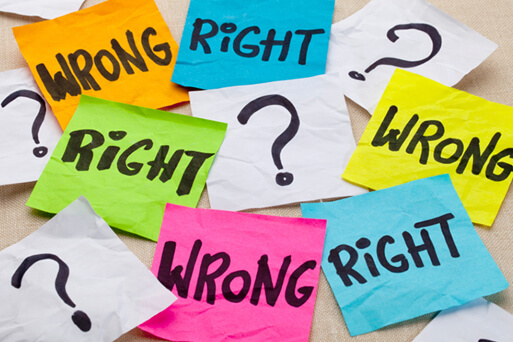
Perhaps a more accurate title for this section would be “Opinions vs Claims.” Beliefs come in two forms, most commonly a belief is just a personal opinion. A belief can also be presented as a claim, or even a guess, about what is factually true.
Whether you are a Christian or not, we can all agree that the truth is important. Our concept of what is true is the basis upon which our daily decisions are made. That is why any claim a person makes should only be respected if it is based on current empirical evidence and reasoning, not on opinions, traditions, authority, or revelation. Many claims contained within the Bible are not based on and are contradictory to current empirical evidence and reasoning. That is why Christianity is harmful, and we need to stop making it socially acceptable to believe that the Bible is a source of truth.
How could so many people
be wrong about Christianity?
If you’re a Christianchances are that everyone around you believes what you do. For one to suggest that Christianity is not true almost sounds like a conspiracy theory. In reality your belief is the minority. Christianity may be the world’s largest religion but only about 33% of the world’s population believes in it and even that 33% is divided on what they believe to be true. Further more, theistic beliefs statistically drop dramatically when it comes to those of higher academia levels. When viewing the whole picture Christianity comes out looking like the conspiracy theory.
Learn More 
Christianity is not just a collection of personal “beliefs,” it is also a collection of claims. Claims that people base personal decisions on, decisions that affect the freedom & well-being of us all.
-
Votes & elections are based on these claims
-
Laws are based on these claims
-
Medical treatments are based on these claims
-
Women’s rights are based on these claims
-
Views of others are based on these claims
-
What children are taught about history & science is based on these claims